


As the demand for breathtaking AI-generated artwork surges, choosing the right graphics card becomes crucial for enthusiasts and professionals alike. This guide unveils top contenders that excel in processing power and efficiency, ensuring you can create stunning visual masterpieces with Stable Diffusion. Discover which GPUs can elevate your creative projects to new heights.
Understanding the Role of Graphics Cards in AI Art Generation
The exponential growth of AI art generation has heightened the importance of selecting the right graphics card, particularly for processes like Stable Diffusion. A powerful GPU not only accelerates the rendering of stunning visuals but also enhances the overall efficiency of the AI model, allowing for quicker iterations when generating and refining art. As AI algorithms become more complex, the demand for high-performance GPUs has surged, making it essential for creators to choose wisely.
When exploring options for optimal GPU performance in AI art generation, several factors come into play. Performance benchmarks indicate significant disparities between different graphics cards. For instance, the NVIDIA RTX 4090 and RTX 4080 showcase remarkable improvements over earlier models like the RTX 3090 Ti, particularly in handling the demands of Stable Diffusion. Such advancements enable artists to produce images faster and with greater fidelity, as the latest architectures optimize both training and inference tasks.
Key Features to Consider:
- Memory Capacity: A higher GDDR6 memory-typically 10GB or more-ensures that larger models can be processed without running into performance bottlenecks.
- Core Count: More CUDA cores enhance parallel processing, which is crucial for handling the complex computations involved in AI art generation.
- Ray Tracing and Tensor Cores: Advanced cores facilitate realistic rendering and efficient machine learning operations, respectively, making them invaluable for modern AI applications.
Example GPUs for Stable Diffusion
| GPU Model | Memory (GB) | CUDA Cores | Ray Tracing Cores | Price (Approx.) |
|---|---|---|---|---|
| NVIDIA RTX 4090 | 24 | 16,384 | 76 | $1,599 |
| NVIDIA RTX 4080 | 16 | 7,680 | 64 | $1,199 |
| NVIDIA RTX 3090 Ti | 24 | 10,752 | 84 | $999 |
Selecting the appropriate GPU is a critical step in harnessing the full potential of AI-driven art generation. Whether one is a seasoned artist or a newcomer to AI models like Stable Diffusion, investing in a capable graphics card is essential for achieving fast, high-quality outputs, ultimately elevating the creative process and workflow.
Key Features to Look for in a Graphics Card for Stable Diffusion
To maximize the performance of Stable Diffusion, understanding the critical features of a graphics card is essential. These attributes not only affect the speed and efficiency of generating images but also determine the overall user experience when running complex AI models. As AI art continues to garner interest, equipping yourself with the right graphics hardware becomes increasingly vital.
Essential Specifications
When selecting a graphics card for Stable Diffusion, key specifications should be prioritized:
- GPU Architecture: Opt for modern architectures like NVIDIA’s Ampere or Ada Lovelace, as they enhance AI processing capabilities.
- Memory Size: A minimum of 10GB of VRAM is recommended for handling large models and generating high-resolution images efficiently.
- Cores and Clock Speed: Higher CUDA core counts and clock speeds contribute to better parallel processing, crucial for AI tasks.
- Thermal Management: Effective cooling systems prevent thermal throttling, allowing sustained performance during intensive operations.
Compatibility and Future-Proofing
It’s also important to consider how well the graphics card integrates with existing hardware. Compatibility with the motherboard, CPU, and power supply must be ensured to avoid bottlenecks. Investing in a graphics card that supports the latest technologies such as Ray Tracing, Tensor Cores, and DirectX 12 can enhance both current and future applications. This forward-thinking approach is particularly relevant as software and AI algorithms continually evolve and require more robust hardware capabilities.
Real-World Examples
For practical guidance, popular models such as the MSI GeForce RTX 5080 with 16GB of GDDR7 memory are highly recommended for their outstanding performance in demanding applications like Stable Diffusion. Similarly, benchmark tests indicate that various Nvidia GPUs consistently outperform competitors in real-world scenarios, making them a reliable choice for artists and developers alike[[1]](
Choosing the right graphics card for Stable Diffusion is not just about specs; it’s about ensuring that the hardware complements your creative ambitions. By focusing on these key features, you will be positioned to create stunning AI-generated art while optimizing your workflow.
Top Graphics Card Recommendations for Different Budgets
When it comes to generating stunning AI art using Stable Diffusion, selecting the right graphics card can significantly impact both performance and creativity. Whether you’re a hobbyist looking for budget-friendly options or a professional seeking top-tier technology, there’s a graphics card tailored for every budget. This diverse landscape of GPUs ensures that artists can fully leverage the capabilities of AI image generation without breaking the bank.
Budget-Friendly Options
For those just starting or working on a tight budget, options like the Nvidia GeForce RTX 3060 are excellent choices. With its solid performance at a reasonable price, this card can handle AI art creation effectively, providing good rendering speeds without demanding a hefty investment. Another strong contender in this category is the AMD Radeon RX 6600, which balances performance and cost, making it ideal for beginners or those dabbling in AI art.
Mid-Range Solutions
As you move up the budget scale, the Nvidia GeForce RTX 3080 offers a remarkable boost in performance that is particularly beneficial for Stable Diffusion applications. Its enhanced memory bandwidth and impressive CUDA core count allow for faster training and inference times, leading to quicker generation of images. Additionally, the AMD Radeon RX 6700 XT presents a comparable alternative, providing excellent performance in AI tasks while maintaining a more affordable price than some of the higher-end models.
High-End and Professional Choices
For professionals or avid gamers alike, investing in a more powerful GPU can yield significant benefits. The Nvidia GeForce RTX 4090 stands out not just for its performance but also for future-proofing capabilities, making it an investment that can pay off as AI art generation becomes more complex and demanding. This card features cutting-edge architecture that excels in deep learning tasks, ensuring that your creative processes remain efficient and highly productive.
For those seeking exceptional performance at a competitive price, the Nvidia A100 is another prime selection, specifically designed for high-demand AI tasks. Though it comes at a premium, its unmatched capabilities in handling large datasets and intricate models cannot be overlooked.
| Graphics Card | Price Range | Key Features |
|---|---|---|
| Nvidia GeForce RTX 3060 | $300 – $400 | Good balance of performance and cost |
| Nvidia GeForce RTX 3080 | $700 – $900 | Enhanced memory bandwidth, fast rendering |
| Nvidia GeForce RTX 4090 | $1,600 – $2,000 | Top-tier performance and future-proofing |
| Nvidia A100 | $11,000 and up | Specialized for high-demand AI tasks |
By selecting the appropriate graphics card based on your budget and performance needs, you can enhance your experience with Stable Diffusion and unlock the full potential of AI-driven art creation. Whether you’re in it for hobby or profession, these recommendations cater to every type of user, ensuring that artistic capabilities are only limited by imagination, not technology.
Comparing AMD vs. NVIDIA: Which is Better for AI Art?
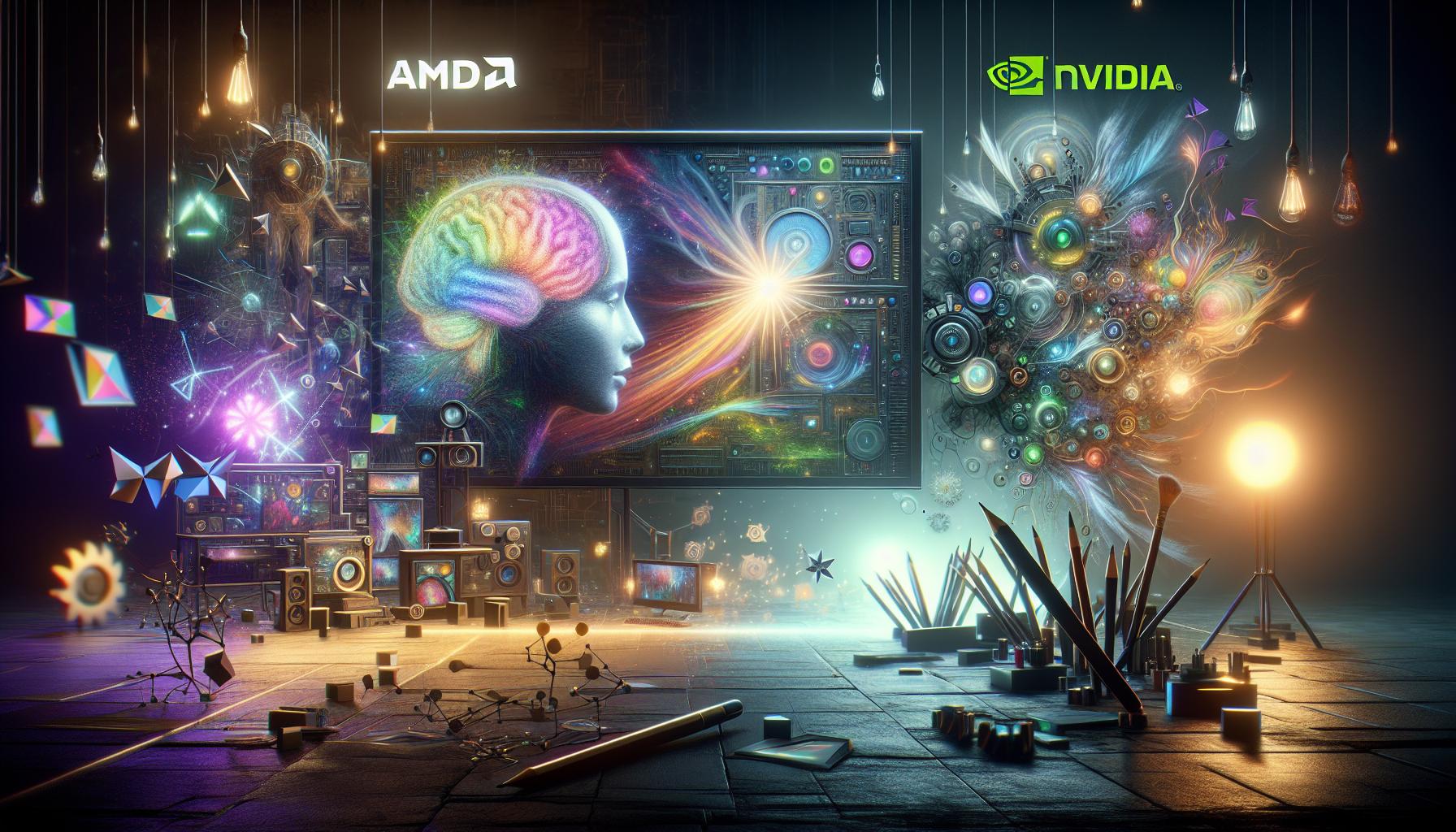
When it comes to generating AI art, especially with popular models like Stable Diffusion, the choice between AMD and NVIDIA graphics cards can significantly impact performance. Both brands offer compelling options, but they cater to different user needs and preferences. The right GPU can enhance your creative process, enabling smoother and faster rendering of intricate art based on simple text prompts.
NVIDIA’s Strengths in AI Art
NVIDIA has long been the archetype for high-performance graphics, with its well-established CUDA cores and Tensor cores optimized for AI workloads. These features make NVIDIA cards particularly adept at handling the heavy lifting required in AI art applications, providing faster image generation and higher detail retention. Additionally, tools such as NVIDIA Studio optimize the driver ecosystem and offer creative apps support, making it a prime choice for artists focusing on generative art.
Performance Comparison
When evaluating AMD versus NVIDIA for AI projects, recent benchmarks reveal significant performance disparities. For instance, while AMD’s Radeon RX 7900 XTX was noted for its graphical prowess, NVIDIA’s offerings, such as the GeForce RTX 4090, have been shown to outperform AMD in several AI art tasks. This swing in performance is particularly noticeable in text-to-image generation, where NVIDIA’s architecture can harness AI model training much more effectively.
| Feature | NVIDIA | AMD |
|---|---|---|
| CUDA Support | Yes (Optimal for AI tasks) | No |
| Ray Tracing | Advanced Ray Tracing | Basic Ray Tracing |
| AI Optimization | Semi-automatic (via Studio drivers) | Less optimized |
| Price Range | Higher-end models may be costly | More budget-friendly options |
AMD’s Value Proposition
Despite NVIDIA’s upper hand in raw capabilities, AMD is rising as a solid contender, especially for budget-conscious artists. AMD’s latest Radeon AI Pro R9700 has been touted for its ability to deliver competitive performance, even outperforming some NVIDIA models in specific multi-tasking AI tasks by up to 5X in certain benchmarks [[3]](https://www.tomshardware.com/pc-components/gpus/amd-launches-radeon-ai-pro-r9700-to-challenge-nvidias-ai-market-dominance). Its value lies in a more accessible price point, allowing artists to experiment with AI art without a hefty investment.
In conclusion, the decision between AMD and NVIDIA for AI art largely depends on your specific requirements. If budget constraints are a primary concern, AMD delivers solid performance; however, for those willing to invest in the best technology available, NVIDIA remains the go-to choice for superior AI art capabilities and software compatibility.
How to Optimize Your Setup for Faster AI Image Rendering
Optimizing your setup for AI image rendering is a game changer, especially when working with generative models like Stable Diffusion. The right hardware configuration not only accelerates the rendering process but also ensures high-quality output with minimal artifacts. Given the complexity of such tasks, understanding GPU performance and its interaction with memory can significantly enhance your workflow.
Choose the Right Graphics Card
Selecting a powerful and compatible graphics card is crucial. For instance, many of Nvidia’s GPUs have proven to be exceptional in handling Stable Diffusion, especially models like the RTX 3000 series and the A100. These GPUs are optimized for multi-batch processing, facilitating the generation of multiple images simultaneously. In contrast, AMD’s RX 7000 series excels by using configurations such as 3×8 batches, while RX 6000 series cards may require specific batch sizes like 6×4 or 12×2 to prevent rendering issues [[1](https://www.tomshardware.com/pc-components/gpus/stable-diffusion-benchmarks)].
Optimize Processing Settings
To maximize your GPU’s capabilities, it’s essential to utilize software designed for AI workloads effectively. Ensure compatibility with GPU acceleration and consider using AI-optimized frameworks like NVIDIA CUDA, cuDNN, and TensorRT. When dealing with larger datasets, batch processing can greatly enhance efficiency. Fine-tuning hyperparameters in your rendering settings is also vital; adjusting these parameters can yield faster generation times while maintaining quality [[2](https://gpuservercase.com/blog/gpu-memory-and-core-optimization-for-ai-workloads/)].
Leverage AI for Load Distribution
Utilizing AI to manage rendering tasks can alleviate pressure on your GPU. For example, by enabling AI to handle smaller scene elements, you allow your GPU to dedicate more resources to rendering the primary subjects. This method results in a smoother rendering process, reducing overall load and potentially leading to quicker generation times. Implementing such strategies can lead to significant improvements in performance [[3](https://forums.developer.nvidia.com/t/optimizing-rendering-with-ai-reducing-gpu-load-for-faster-processing/330890)].
Monitor and Maintain Your Environment
Regularly monitoring your system’s performance ensures you swiftly identify and address potential bottlenecks. Tools that provide insights into memory usage and processing loads can help in fine-tuning your setup over time. Also, ensure your cooling solutions are adequate; overheating can severely throttle GPU performance, leading to longer render times and crashes, which can interfere with your creative flow.
By focusing on these aspects-choosing the right graphics card, optimizing settings, utilizing AI effectively, and maintaining system health-you can significantly enhance the efficiency and speed of your AI image rendering projects. This approach will not only make your work faster but also ensure the quality that artists and developers expect when generating stunning AI art.
Real-World Performance: Benchmarks for AI Art Applications
The rapid evolution of AI-driven art generation has sparked a surge in interest in optimized hardware solutions capable of supporting high-performance tasks. As artists and developers dive into platforms like Stable Diffusion, understanding the critical role of graphics cards becomes essential. Graphics processing units (GPUs) are not just conduits for rendering; they are pivotal in determining the speed and quality of artwork production.
Benchmarking real-world performances of various GPUs reveals significant disparities in efficiency and output quality suitable for AI art applications. For instance, when evaluating popular models like the NVIDIA RTX 3080, 3090, and newer offerings such as the RTX 4080 or RTX 4090, users can observe the variation in training times and image generation capabilities. Typically, a high-end card such as the RTX 4090 can generate images significantly faster than its predecessors, delivering results in mere seconds, which can be a game-changer in a fast-paced creative environment.
Performance Benchmarks
To facilitate decision-making, consider a comparison of key specifications and performance metrics of various graphics cards:
| Graphics Card | CUDA Cores | VRAM | Performance (FPS) | Typical Price |
|---|---|---|---|---|
| NVIDIA RTX 3080 | 8704 | 10GB | 30-50 | $700 |
| NVIDIA RTX 3090 | 10496 | 24GB | 50-70 | $1500 |
| NVIDIA RTX 4080 | 9728 | 16GB | 40-60 | $1200 |
| NVIDIA RTX 4090 | 16384 | 24GB | 60-80 | $2000+ |
This table illustrates how advancing technology not only enhances computational power but also supports higher resolutions and complex models that delve into intricate details of AI-generated art. By selecting a GPU that best fits an artist’s specific workload-whether it’s real-time image generation or extensive batch processing-creators can unlock the full potential of tools like Stable Diffusion.
Consider also the importance of software compatibility. The right drivers and frameworks can maximize performance, allowing users to fully leverage the capabilities of their selected graphics card. Engaging with communities and forums can also offer insights on overclocking options or modifications that further enhance GPU performance for art-centric applications, ensuring that users not only select the best hardware but also optimize it for their unique artistic processes.
Troubleshooting Common Issues with Graphics Cards in Stable Diffusion
To achieve outstanding results with Stable Diffusion, having the right graphics card is crucial. However, even with top-tier hardware, users may encounter challenges that affect performance and image generation. Addressing these common issues can significantly enhance the user experience and ensure optimal results.
Identifying Performance Bottlenecks
One of the primary concerns when using graphics cards for AI image generation is ensuring that performance bottlenecks are identified and remedied. Users may notice slow processing times or unusually long rendering periods. These issues can often be attributed to insufficient VRAM. For instance, if you are running a powerful model on a card with less than 8GB of VRAM, you are likely to encounter lag and reduced efficiency. Upgrading to a card such as the NVIDIA RTX 4080 or newer can alleviate this problem, as these cards come equipped with ample VRAM to handle complex tasks effectively.
Driver Issues and Compatibility
Another common stumbling block lies in software compatibility, primarily around graphics card drivers. Outdated or incompatible drivers can lead to instability during operation, which may result in crashes or freezes during image generation. It is essential to regularly update your graphics card drivers directly from the manufacturer’s website. This simple maintenance step can resolve many functional issues right away. Moreover, ensuring that your software packages, such as TensorFlow or PyTorch, are up-to-date can optimize performance and give users access to the latest enhancements in image generation.
Optimizing Settings for Best Results
To minimize errors in image generation, it is crucial to adjust the settings within the Stable Diffusion software. Users should begin by fine-tuning resolution and batch size configurations according to their hardware capabilities. For example, generating images at higher resolutions may require additional computational power; thus, adjusting the batch size can lead to better performance without overloading the GPU. If crashes persist, it’s wise to switch to lower resolutions or reduce the number of images processed simultaneously.
While leveraging strong models like Stable Diffusion can produce beautiful AI art, proper troubleshooting can mitigate frustrations and elevate the creation process. By being mindful of performance bottlenecks, updating drivers, and optimizing settings, users can maximize their graphics card’s potential and ensure stunning outputs in less time.
Future Trends in Graphics Technology for AI Art Enthusiasts
As advancements in technology continue to reshape the landscape of graphic design and digital art, staying informed about emerging trends is crucial for those passionate about AI art. With the continuous improvement in graphics processing units (GPUs) and the evolving software technologies used in AI art generation, enthusiasts can expect a significant transformation in their creative workflows. The intersection of powerful graphics cards and AI algorithms is becoming a pivotal aspect of creating stunning visual artworks that push the boundaries of traditional aesthetics.
Emerging GPU Technologies
The future of graphics technology for AI art enthusiasts is bright, primarily due to the development of specialized GPUs designed for deep learning applications. Current top picks for Stable Diffusion benefit from innovations such as:
- Tensor Cores: Found in the latest NVIDIA RTX series, Tensor Cores accelerate AI workloads, making tasks like image generation faster and more efficient.
- Ray Tracing: Enhancements in ray tracing technology allow for more realistic lighting and shadow effects in AI-generated art, improving aesthetic quality.
- Increased VRAM: More video memory enables handling larger datasets and more complex models, critical for high-resolution images and detailed artwork.
This explosive trend in GPU capability means that artists can look forward to rendering high-quality images in real-time, a critical requirement that aligns with popular AI art tools.
Software Integration and AI Models
Looking ahead, the integration of GPUs with advanced AI models like DALL-E and Midjourney will continue to pave the way for innovative art creation. AI tools are becoming increasingly user-friendly, empowering artists who may not have an extensive technical background to create sophisticated artwork. Community-driven platforms are beginning to emerge, providing access to shared resources, tutorials, and collaborative opportunities, all designed to enhance the user experience.
As these tools become more accessible, artists will find themselves able to produce high-quality art quicker than ever, allowing for iterative design processes that were previously restricted by technical barriers.
Real-World Applications
The implications of these developments extend beyond the artist’s studio. Businesses, advertising agencies, and independent creators are leveraging AI-generated art for diverse applications, enhancing marketing strategies, visual storytelling, and brand identity. Tools that harness AI art creation not only provide artistic value but also foster a new business model that melds creativity with technological innovation.
For example, companies incorporating AI-generated imagery have reported faster turnaround times for campaigns and increased engagement from audiences due to the high-quality and personalized visuals. As AI art captures the attention of collectors and consumers alike, the demand for powerful graphics cards will only grow, one that supports the latest artistic techniques and ensures rapid production without sacrificing quality.
Embracing these trends will be essential for anyone involved in the world of AI art. The synergy between cutting-edge GPUs and sophisticated AI models is set to revolutionize the art world, making it an exciting time for artists and creators to explore new frontiers in creativity.
Q&A
What graphics card do I need for Stable Diffusion?
For Stable Diffusion, a good graphics card is crucial. You need an NVIDIA GeForce RTX GPU with at least 8 GB of GDDR6 memory for optimal performance.
These requirements ensure the GPU can handle the processing demands of AI image generation. Popular models include the RTX 3060 and RTX 3090, which excel in generating high-quality images rapidly.
Can I use AMD graphics cards for Stable Diffusion?
While Stable Diffusion primarily supports NVIDIA, some AMD graphics cards can run it, but performance may vary. NVIDIA cards are preferred due to better software optimization.
If you already own an AMD card, you might still explore community versions of Stable Diffusion that offer compatibility. However, expect limitations in speed and quality compared to NVIDIA options.
Why does Stable Diffusion require a powerful GPU?
A powerful GPU is essential for Stable Diffusion as it handles the heavy processing tasks involved in AI image generation, particularly with neural networks.
The GPU’s architecture allows for parallel processing, making it capable of managing multiple calculations simultaneously, which is critical for achieving fast and efficient rendering of images.
What are the top picks for graphics cards for Stable Diffusion?
Top picks include the NVIDIA GeForce RTX 3090 for its 24 GB memory, followed by the RTX 3080 and RTX 3070 for budget-friendly options. Each offers a balance of performance and price.
These options can handle complex AI tasks and improve your experience with Stable Diffusion. It’s vital to choose a card based on your needs and budget, considering both performance and cost.
How much RAM do I need for Stable Diffusion?
You should have at least 16 GB of RAM to ensure smooth operation of Stable Diffusion alongside your GPU. This amount helps manage the data being processed without bottlenecking performance.
Insufficient RAM can lead to slowdowns, crashes, or inability to generate images effectively. Upgrading to 32 GB can provide even better performance, especially for larger image generations.
Can I run Stable Diffusion without a powerful GPU?
While it’s possible to run Stable Diffusion without a powerful GPU, performance will be severely limited. Lower-spec GPUs may struggle, resulting in longer render times and reduced image quality.
If your hardware does not meet the requirements, consider using cloud services like Google Colab, which provides access to powerful GPUs without upfront investment in hardware.
What is the minimum storage requirement for Stable Diffusion?
You need a minimum of 10 GB of free storage space to install and run Stable Diffusion efficiently. This space is necessary for storing models, images, and related data.
Make sure your storage is fast (SSD recommended) to improve loading times and overall performance. Additional storage may be required for saving generated images and any custom assets you create.
Where can I find more information about graphics cards for AI art?
For more detailed insights, check out our resources on the best graphics cards for Stable Diffusion. These articles provide comparisons and recommendations based on various budgets and needs.
Stay informed about the latest advancements in AI art generation to make the best investment for your creative projects.
Closing Remarks
In conclusion, choosing the right graphics card for Stable Diffusion is crucial for maximizing your image generation capabilities. Opting for modern GPUs, especially from NVIDIA, such as the RTX 4090 or 4080, can significantly enhance performance due to their superior clock speeds and memory bandwidth. These cards not only handle larger batches of images but also excel in generating high-resolution outputs, providing a seamless experience for creators. While midrange options can suffice, investing in more powerful GPUs unlocks the full potential of AI art generation.
Whether you’re an experienced developer or just starting out, understanding these technical aspects empowers you to create stunning artworks with ease. Dive deeper into the world of AI visual tools, experiment with different models, and let your creativity flourish by utilizing the power of the right hardware. Explore, innovate, and bring your artistic vision to life with the perfect graphics card for Stable Diffusion!


